
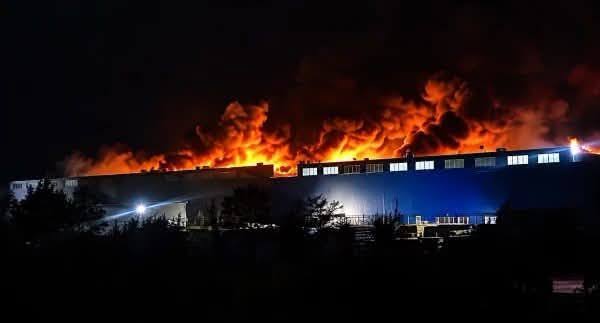
On the night of October 8, a Ukrainian drone found its way to Sasovo, a mid-sized city in the Ryazan region of Russia, and lit a Yandex data center on fire. No one was hurt. Two supercomputers, “Lyapunov” and “Chervonenkis,” named after mathematicians because Russia was going through something, were housed inside. Chervonenkis had once ranked 19th on the global Top500 list of most powerful machines on earth. It has since slipped out of the top hundred, largely because Western sanctions made upgrades hard. The irony of that detail is left to the reader.
Ukraine wasn’t done. On October 9, drones hit a Yandex facility in Kaluga. On October 11, a data center in Vladimir shut down entirely after another strike. Yandex, which is essentially Russia’s Google if Google had always been a little more comfortable with authoritarianism, said the attacks had “struck at the core of its operations.” Shares dropped more than 3% on the Moscow Exchange. Roughly 100,000 Russian households lost internet access. Yandex Cloud, Yandex Disk, Russian Railways, and several regional government websites went offline.
Then something interesting happened.
Cloudflare Radar, which tracks internet traffic, showed that automated HTTP requests from Yandex’s AS13238 network — the kind of traffic bots generate when they’re busy being bots — fell from roughly 88% of normal to 0.3% within days of the first strike. Over the preceding week, 99.6% of all HTTP requests from the network had been classified as automated. On October 12, Volodymyr Zelenskyy stood at the Warsaw Security Forum and told the room that Russian social media bot activity had “noticeably declined” since the strikes. “Everyone noticed,” he said.
A Czech member of the European Parliament named Tomáš Zdechovský looked at the bot traffic data and publicly asked whether the disruption had also affected online support for Germany’s AfD party, which has benefited enormously from coordinated pro-Russia social media activity. No one has confirmed the link. But no one has denied it either.
To be clear about what this means in plain language: Russia built a server farm. That server farm ran supercomputers. Those supercomputers powered automated bot networks. Those bot networks spent years flooding Western social media with content designed to make you distrust your neighbors, fear immigrants, hate your government, and vote for whoever Moscow preferred. Ukraine burned the server farm down. The bots went quiet. And somewhere in Germany, a guy who’d spent three years nodding along to Facebook posts about demographic replacement is sitting in unusual silence, wondering why his feed suddenly feels different.
Zelenskyy, for his part, was unbothered. “We always respond in mirror-like fashion,” he said. Russia had, since September 23, destroyed data centers belonging to at least eight Ukrainian companies. Ukraine responded by destroying the building where Russia kept its brain.
This is a real thing that actually happened.